


COBOL, short for Common Business-Oriented Language, has supported core business operations for decades, particularly for industries like banking, insurance, and government. COBOL applications remain in use today because they are reliable, but outdated interfaces and limited integration capabilities often make them difficult to use and connect to modern technologies.
COBOL application modernization helps organizations overcome these challenges, often without the need to rewrite their existing code. In this guide, we'll explore the different modernization strategies, their benefits, and how to choose the right approach for your existing systems.
What is COBOL?
First developed in 1959, COBOL was designed for business data processing. Known for its reliability and ability to process large transaction volumes, it remains widely used in banking, insurance, government, and other industries.
Many COBOL applications run on mainframe systems to support core operations such as payment processing, financial reporting, and records management. In fact, IBM estimates that 250 billion lines of COBOL code remain in production today.
Although COBOL coded applications continue to perform these tasks reliably, the systems built around it may struggle to meet modern expectations for accessibility, usability, and integration.
What is COBOL modernization?
COBOL modernization helps businesses adapt their existing applications to meet modern requirements. Depending on your objectives, this could involve:
- Modernize the user interface: Replace traditional green-screen experiences with intuitive, browser-based interfaces.
- Improve system integration: Connect COBOL applications to modern platforms through APIs and web services.
- Optimize existing applications: Refactor COBOL code, update development tools, or improve application performance.
- Migrate workloads: Move selected applications to different infrastructure, including cloud environments.
- Replace legacy components: Rebuild specific functions using newer programming languages where there's a clear business case.
The right approach depends on what your existing system does well, where its limitations lie, and what you want modernization to achieve.
How COBOL modernization can improve business operations
Although COBOL applications continue to handle demanding workloads, the technology surrounding them doesn't always meet modern business needs. You might consider COBOL modernization to:
1. Improve accessibility and usability
Traditional COBOL applications tend to rely on terminal-based interfaces that require specialist knowledge to navigate. These green-screen systems may be familiar to experienced employees, but they aren't intuitive and have a steep learning curve for new users.
Modern web interfaces can simplify everyday tasks, reduce repetitive data entry, and make COBOL applications easier to access and use across desktops, laptops, tablets, and smartphones.
2. Integrate with modern applications
Modern businesses rely on connected platforms, from CRM and ERP software to cloud-based services and customer portals. However, COBOL applications don't always integrate easily with these modern systems, leaving employees to transfer data manually.
COBOL modernization can address this challenge by using APIs and web services to connect legacy applications to newer technologies. This helps organizations reduce manual data entry, streamline workflows, and make critical business information more accessible, all while retaining the core systems they rely on.
3. Reduce dependence on specialist skills
As experienced COBOL developers retire, organizations can face a shortage of specialists with the skills needed to maintain their legacy applications. This can be a major hurdle when systems are poorly documented or highly customized.
For example, a 2025 US Government Accountability Office report identified a shortage of people with the skills needed to support some key federal systems that use COBOL and assembly language.
That said, the challenge extends beyond COBOL expertise. According to Kyndryl's 2025 State of Mainframe Modernization report, 70% of surveyed organizations reported difficulty finding the talent needed for mainframe modernization, particularly in areas such as AI, cloud technology, and systems integration.
Modern development tools and clearer documentation can make COBOL applications easier to maintain, while more intuitive interfaces reduce the training needed for everyday users. However, specialist developers will still be needed to support the underlying code.
4. Reduce operational risk
Legacy applications often support business-critical processes. That means any unexpected downtime, data inconsistencies, or lost functionality can have serious operational consequences.
By adopting a controlled modernization strategy, organizations can address specific limitations while keeping core systems stable. Modernization also provides an opportunity to review security controls, user access, and application dependencies.
What are the main COBOL modernization strategies?
There is no single way to modernize a COBOL application. Some organizations must update their code, while others can achieve their objectives by improving how users and other applications interact with it.
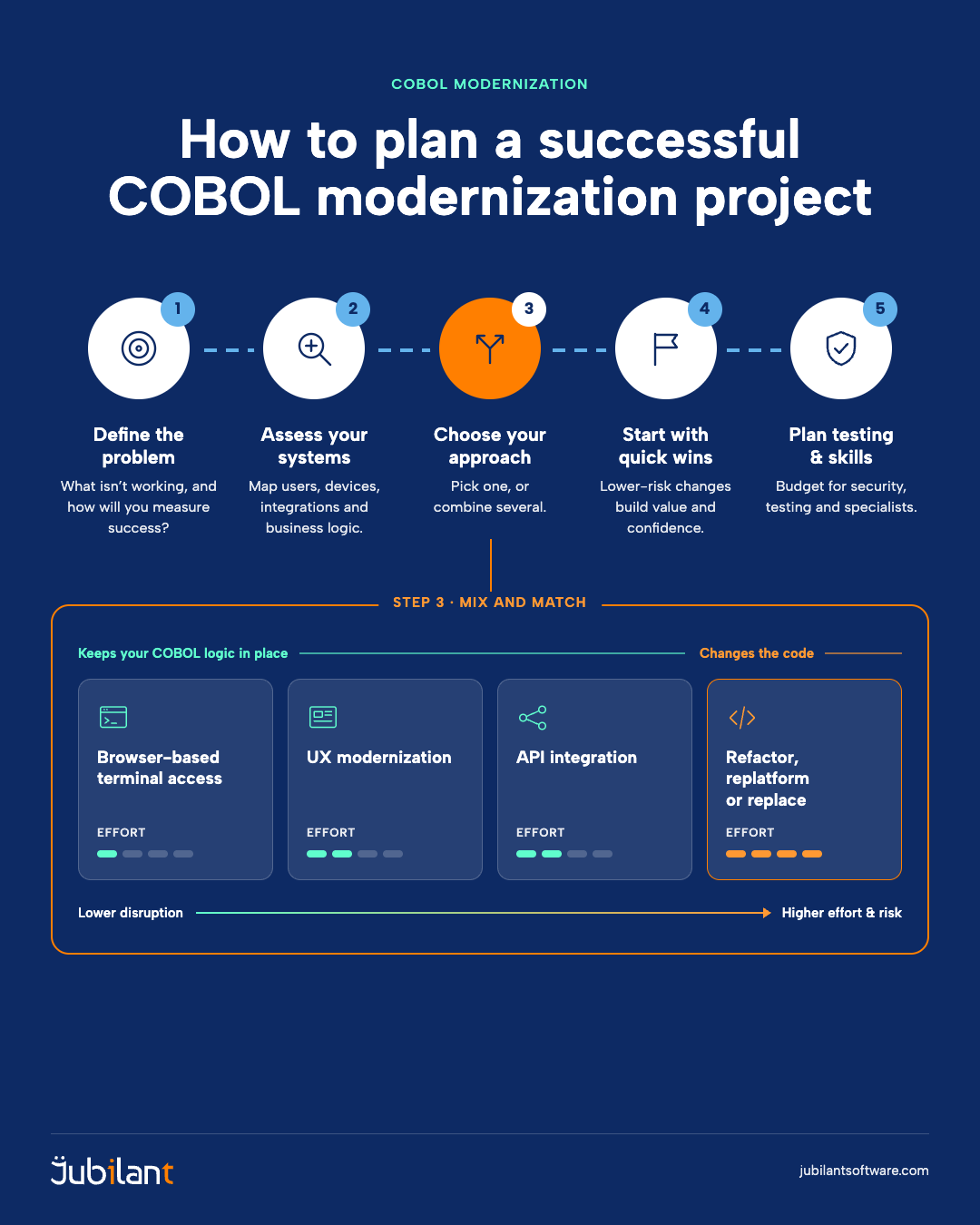
1. Modernize terminal access
A useful starting point for many organizations is simply changing how employees access existing applications. Traditional terminal emulation often requires installing software and maintaining each device. This can quickly become a lot of work for IT teams and makes remote access more difficult to manage.
Browser-based terminal emulation removes this dependency, allowing authorized users to access host applications through a modern web browser. This approach supports centralized administration, remote access, and modern authentication requirements without modifying the underlying COBOL programs.
For organizations whose main challenges relate to accessibility and terminal maintenance, this approach offers a relatively low-disruption first step.
2. Transform legacy user interfaces
Browser-based access makes host applications easier to reach, but it doesn't necessarily improve how employees interact with them. That's where UX modernization comes in. This process transforms traditional terminal screens into responsive, web-based interfaces.
For example, an employee might have previously needed to navigate several green screens to retrieve customer details. A modern interface could consolidate the relevant customer fields into a single view. This makes workflows more intuitive without having to rewrite any of the underlying COBOL logic.
3. Connect COBOL applications through APIs
Many organizations rely on COBOL applications to manage critical business data, but connecting them with newer software isn't always straightforward. API integration allows modern platforms, including cloud services and customer portals, to access that data and use existing application functions.
For example, an insurance company could use web services to make information from its policy administration system available to a modern customer-facing application. With this method, the original application can remain the system of record, while new services provide additional capabilities.
4. Refactor, replatform, or replace applications
In some cases, the limitations extend beyond the user interface or integration layer. An organization may need to refactor legacy code to optimize performance, adopt newer development practices, migrate workloads, or replace selected application components, such as reporting modules or data-processing routines.
These approaches can offer long-term benefits, but often require more extensive planning, testing, and specialist expertise. A complete rewrite may be appropriate when existing technology can no longer meet business requirements cost-effectively. However, organizations must weigh the potential benefits against the costs and risks of recreating decades of embedded COBOL business logic.
How to plan a successful COBOL modernization project
Successful COBOL modernization involves a clear understanding of your existing systems, well-defined objectives, and careful planning. No two projects are the same, but it should generally follow these steps:
1. Assess your existing systems
Begin by assessing your legacy COBOL systems, including the supporting infrastructure and dependencies. Then, identify which systems are critical to the business, how employees access them, and where limitations impact day-to-day operations.
At this stage, look for common problems such as complicated workflows, outdated interfaces, or difficulties sharing data with newer applications. This should help you identify where modernization could make the biggest positive impact.
2. Set clear, measurable goals
Next, consider what you want to achieve through modernization. Your priorities might include simplifying access to applications, improving the user experience, reducing IT maintenance, boosting scalability, or connecting COBOL systems with newer software.
You should also set measurable goals to assess the impact of modernization. These might include reducing transaction processing times, cutting manual data entry, or lowering software maintenance costs.
3. Choose the right modernization approach
After assessing your existing COBOL-based systems and defining your objectives, you can determine which modernization strategy best meets your needs. For example, if your COBOL applications work well but employees struggle with outdated interfaces, UX modernization could be a suitable option that doesn’t rewrite any existing code.
A good rule of thumb is to compare cost, complexity, and potential disruption of each option before deciding which is right for the organization.
4. Test before deployment
COBOL applications often support complex, mission-critical systems, so thorough testing helps minimize the risk of disruption. Be sure to test your modernized applications against existing workflows, checking:
- Functionality
- Data accuracy
- Performance
- Security
Check how changes might affect connected systems and existing dependencies. Start with a small group of users to identify and resolve any issues before rolling out the changes more widely.
5. Minimize business disruption with a phased rollout
You don’t have to modernize everything at once. Phased modernization means you can prioritize improvements and assess their impact before proceeding.
For example, you could start with browser-based terminal access, then modernize high-priority workflows before introducing API integrations. Whatever approach you choose, remember to monitor your results against original goals, gather employee feedback, and use these findings to support the next stage of the modernization process.
Modernize access to your legacy applications with Jubilant
Your COBOL applications may still perform reliably, but it's likely they can work better for your business.
At Jubilant, we help organizations modernize their legacy systems without unnecessary disruption. From browser-based terminal access and modern user interfaces to API integration, our solutions make existing applications easier to use, manage, and connect with newer technologies.
Whether you're looking to reduce IT maintenance, improve employee productivity, or extend the value of your existing infrastructure, we can help you find the right approach.
Get more from your existing COBOL systems without starting from scratch. Talk to Jubilant about your modernization options.


